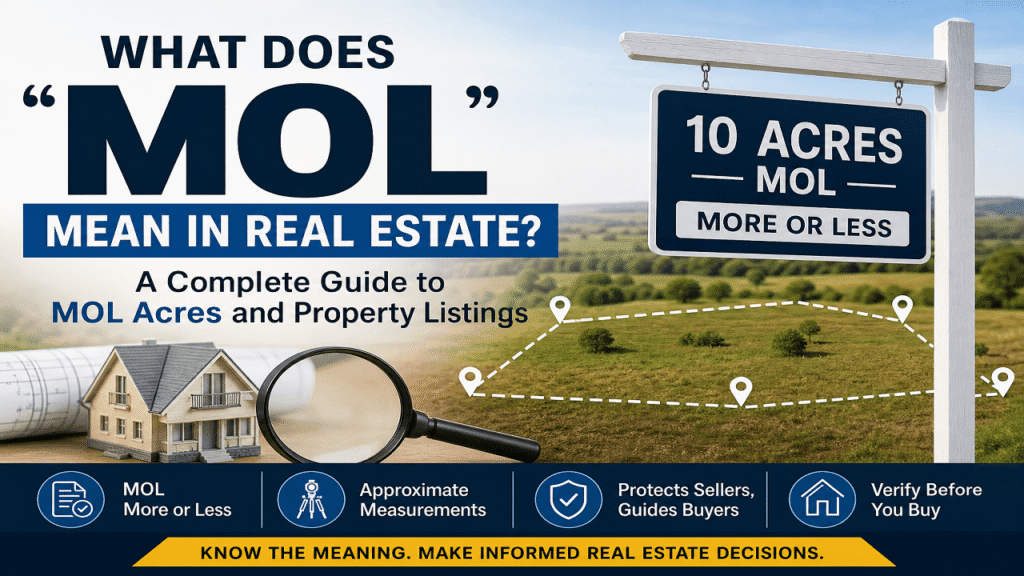
If you’ve ever browsed property listings, you’ve likely come across unfamiliar abbreviations. One of the most common—and often misunderstood—is what MOL means in real estate. This small term can carry big implications for buyers, sellers, and investors.
In simple terms, MOL in real estate stands for “more or less.” However, the real meaning goes deeper than those words alone. It reflects uncertainty in property size and serves as a practical tool in listings where exact measurements are not confirmed.
Understanding the meaning of real estate helps you avoid confusion, make smarter decisions, and protect your investment. Whether you’re buying land, selling a home, or investing in property, knowing how mol acres work can save you time and money.
Table of Contents
What Does MOL Mean in Real Estate?
The phrase what does mol mean in real estate refers to the abbreviation “MOL,” which stands for “more or less.” It indicates that the size, dimensions, or quantity of a property is approximate rather than exact.
For example:
- “10 acres MOL” means the property is approximately 10 acres.
- The actual size could be slightly more or slightly less.
Real estate professionals use MOL when:
- Exact measurements are unavailable.
- A survey has not been completed.
- The listing is based on older or estimated data.
This flexible wording protects sellers while signaling to buyers that they should verify details independently.
What Does MOL Stand for in Real Estate Listings?
When you see what ” mol ” stands for in real estate, the answer is straightforward: More or Less.
However, in practice, it serves several purposes:
- It communicates approximation
- It reduces legal liability for exact figures.
- It gives agents flexibility during early listings.
You’ll often find MOL used in:
- Acreage descriptions
- Lot sizes
- Land parcels
This makes it especially common in rural and undeveloped property listings.
Understanding MOL Acres: A Simple Explanation
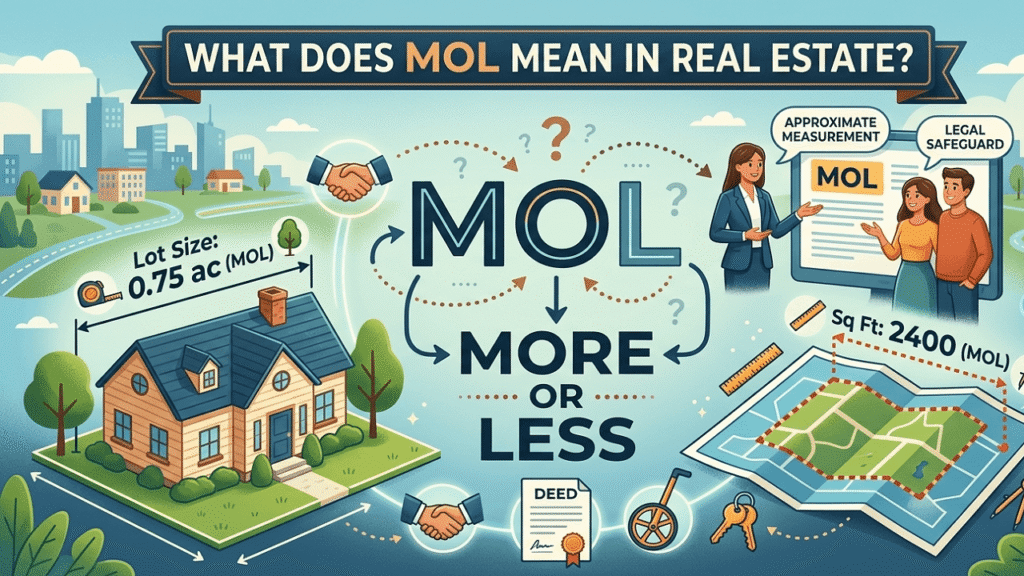
The term mol acres refers to land measurements that are not exact.
For instance:
- “5 acres MOL” could mean 4.8 acres or 5.3 acres.
- The difference depends on survey accuracy.
This approximation exists because:
- Land boundaries may not be clearly defined.
- Older records may be outdated.
- Natural features can affect measurements.
In short, mol acres provide a general idea, not a guaranteed figure.
Why Do Agents Use MOL in Real Estate?
There are several reasons why professionals rely on mol in real estate:
1. Flexibility in Listings
Agents can list properties quickly without waiting for precise surveys.
2. Legal Protection
Using MOL reduces the risk of disputes over minor discrepancies.
3. Practical Marketing
It allows sellers to present a property without committing to exact numbers too early.
Because of these advantages, the term ” mol meaning real estate has become standard practice in many markets.
How Accurate Are MOL Measurements?
When dealing with what ‘mol’ means in real estate, accuracy is a key concern.
MOL measurements typically:
- Are close to actual size
- It can vary slightly depending on the source
- Should not be considered final
The margin of error can range from:
- A few square meters in residential lots
- Several acres in large rural properties
To get exact figures, a professional survey is always recommended.
MOL in Real Estate vs Exact Acreage
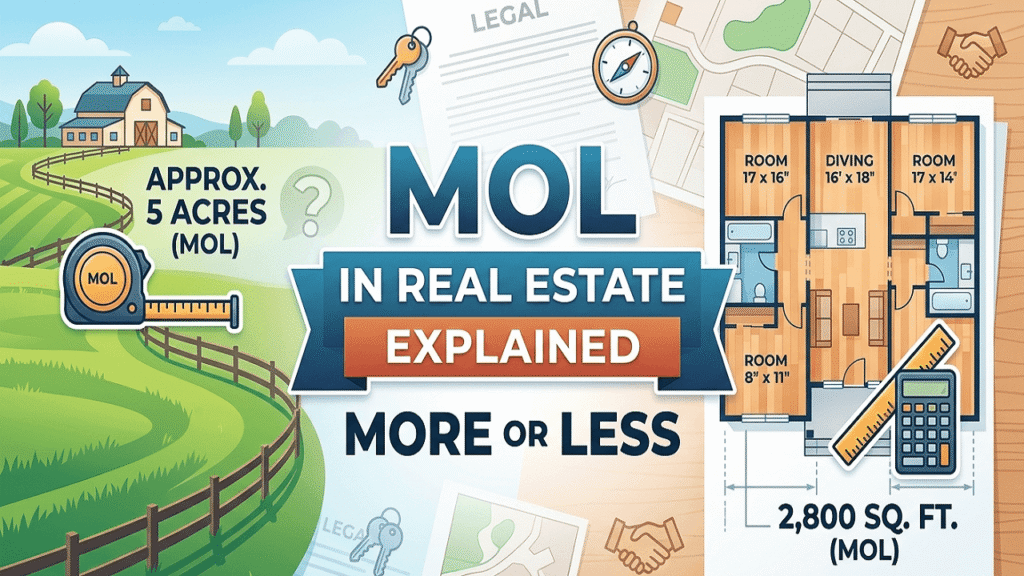
Understanding the difference between mol acres and exact acreage is critical.
| Feature | MOL Acreage | Exact Acreage |
|---|---|---|
| Precision | Approximate | Exact |
| Legal reliability | Limited | High |
| Use case | Early listings | Final transactions |
Exact acreage is usually required for:
- Legal contracts
- Financing approvals
- Property valuation
Meanwhile, mol in real estate is more about convenience and flexibility.
Common Scenarios Where MOL is Used
You will most often encounter mol meaning real estate in these situations:
- Rural land sales
- Agricultural properties
- Large estates
- Undeveloped land
In urban areas, MOL is less common because properties are typically surveyed with greater precision.
Benefits of Using MOL in Real Estate Listings
Using what does mol mean in real estate offers several benefits:
Faster Listings
Properties can be marketed quickly without waiting for surveys.
Reduced Liability
Sellers avoid disputes over small measurement differences.
Flexibility
Listings remain adaptable during negotiations.
These advantages make MOL a practical tool in real estate marketing.
Drawbacks and Risks of MOL in Real Estate
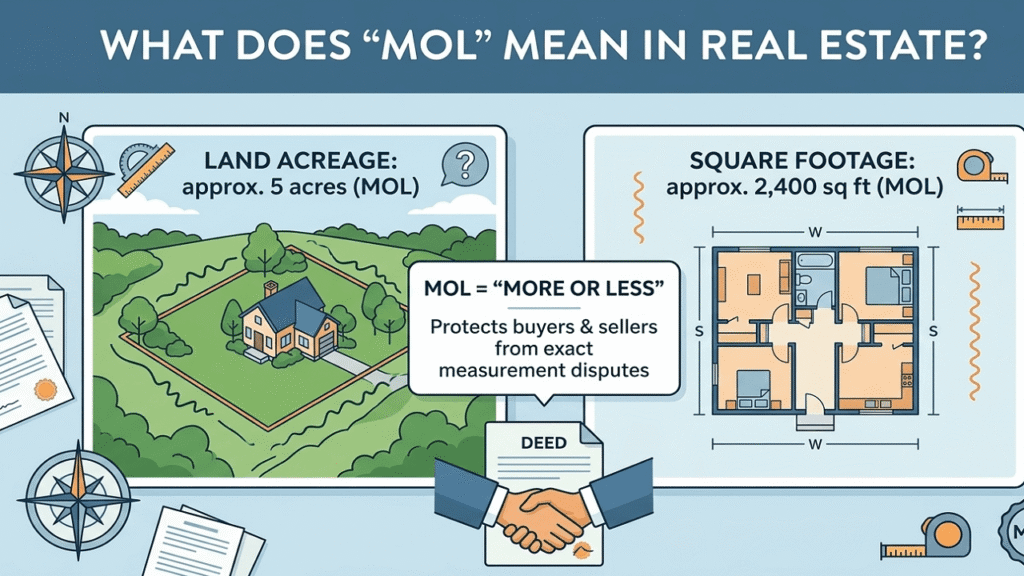
Despite its usefulness, mol in real estate has downsides:
Potential Confusion
Buyers may assume the size is exact.
Financial Risks
Small differences can impact property value.
Legal Disputes
Misunderstandings can lead to conflicts.
Because of these risks, buyers must approach MOL listings carefully.
How Buyers Should Interpret MOL Listings
If you’re dealing with mol acres, follow these steps:
- Always request a survey
- Verify property boundaries
- Ask for official documentation
- Do not rely solely on listing descriptions
Understanding what mol means in real estate helps you avoid costly mistakes.
How Sellers Should Use MOL Correctly
Sellers should use the term real estate responsibly:
- Be transparent about approximations
- Encourage buyers to verify details
- Avoid misleading descriptions
Clear communication builds trust and reduces disputes.
MOL in Land vs Residential Properties
MOL in real estate appears more often in land transactions than residential sales.
Why?
- Land boundaries are harder to define
- Surveys may not exist
- Larger areas increase uncertainty
Residential properties usually have precise measurements, making MOL less necessary.
Legal Considerations of MOL in Real Estate
Legally, what does “mol” mean in real estate, and how does it affect contracts?
Key points:
- MOL does not guarantee the exact size
- Buyers are responsible for due diligence
- Contracts may include disclaimers
For more legal insights, you can review resources like the National Association of Realtors.
MOL and Property Surveys: What You Need to Know
A survey is the best way to confirm mol acres.
Benefits of a survey:
- Accurate measurements
- Clear boundaries
- Legal protection
While surveys cost money, they provide peace of mind and prevent disputes.
Tips for Verifying MOL Acreage Before Buying
To safely handle mol in real estate, follow this checklist:
- Hire a licensed surveyor
- Review land records
- Check zoning documents
- Confirm boundaries physically
These steps ensure you know exactly what you’re buying.
Real-Life Examples of MOL in Property Listings
Example:
- “20 acres MOL with lake access”
- Actual size after survey: 19.6 acres
Lesson:
Even small differences can affect:
- Price
- Usage
- Investment value
Understanding the meaning of ” mol ” in real estate helps interpret such listings correctly.
Common Misunderstandings About MOL Meaning in Real Estate
Myth 1: MOL means exact size
Reality: It is only an estimate
Myth 2: Differences are always small
Reality: Variations can be significant
Myth 3: Surveys are optional
Reality: They are essential for accuracy
Clearing these misconceptions is key to making informed decisions.
Expert Tips for Buyers and Investors
- Never skip due diligence
- Use MOL as a guideline, not a fact
- Negotiate based on verified data
- Work with experienced agents
Smart investors treat what does mol mean in real estate as a starting point, not a final answer.
Personal Insight: Is MOL Good or Bad in Real Estate?
From a practical perspective, mol in real estate is neither good nor bad—it depends on how you use it.
For sellers, it offers flexibility and speed. For buyers, it introduces uncertainty that must be managed carefully.
In my experience, MOL works best when:
- Both parties understand its meaning
- A survey follows before closing
Problems arise only when assumptions replace verification. So, the real issue is not MOL itself, but how people interpret it.
FAQ Section
What does MOL mean in real estate listings?
MOL in real estate stands for “more or less.” It indicates that the property size or dimensions listed are approximate rather than exact. This term is commonly used when a property has not been recently surveyed or when exact measurements are unavailable. Buyers should treat MOL as a general estimate and not a guaranteed figure. It serves as a disclaimer to protect sellers and agents from liability related to minor discrepancies in size. However, buyers should always verify the actual dimensions through official documents or a professional survey before making a purchase decision.
How much difference is allowed in MOL acres?
There is no fixed rule for the amount of variation allowed in MOL acres. The difference can vary depending on the property type, location, and available records. In smaller residential lots, the variation is usually minimal. However, in large rural or agricultural properties, the difference can be more noticeable. This is why buyers should not rely solely on MOL figures. A land survey is the most reliable way to determine the exact acreage and avoid surprises.
Is MOL legally binding in real estate contracts?
MOL is not legally binding regarding the exact property size. Instead, it acts as a disclaimer indicating approximation. Most real estate contracts include clauses that emphasize the importance of buyer verification. While MOL protects sellers from minor discrepancies, it does not replace the need for accurate documentation. Buyers are responsible for conducting due diligence before finalizing a transaction.
Should I trust MOL acreage when buying land?
You can use MOL acreage as a starting point, but you should not rely on it entirely. It provides a general idea of the property size but does not guarantee accuracy. Before purchasing land, it is essential to verify the acreage through a professional survey and review official records. This ensures that you understand exactly what you are buying and helps prevent disputes or financial loss.
Does MOL affect property value?
Yes, MOL can impact property value, especially if the actual size differs significantly from the estimate. Even small variations in acreage can influence pricing, particularly in high-value or large land transactions. Buyers and investors should base their decisions on verified measurements rather than approximate figures to ensure fair pricing and accurate valuation.
Final Verdict
Understanding what mol means in real estate is essential for anyone involved in property transactions. MOL, which stands for “more or less,” provides a practical way to describe approximate property sizes when exact measurements are unavailable. While it offers flexibility and convenience for sellers and agents, it also introduces a level of uncertainty that buyers must handle carefully.
The key takeaway is simple: MOL should never replace proper verification. It serves as a guideline, not a guarantee. Buyers who rely solely on MOL listings risk misunderstandings, financial discrepancies, and even legal issues. On the other hand, those who take the time to confirm details through surveys and official documents can confidently move forward with their investment.
For sellers, using MOL responsibly means being transparent and encouraging due diligence. This builds trust and helps avoid disputes later in the process.
In today’s real estate market, knowledge is power. By fully understanding mol acres and mol meaning real estate, you position yourself to make smarter, safer, and more informed decisions.